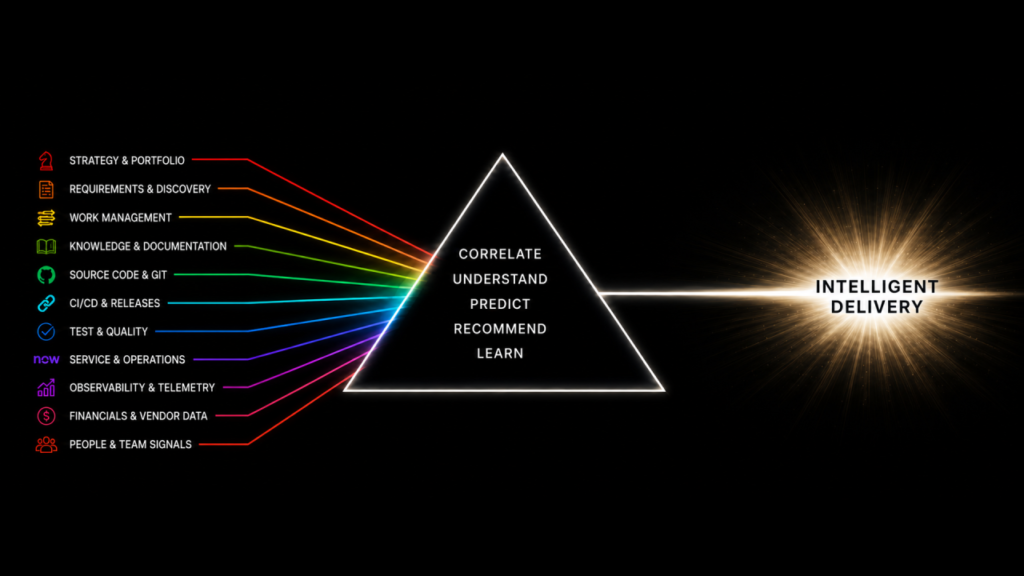
The Platform the Market Needs to Build
I believe the next major enterprise software category is beginning to emerge, but no platform has assembled it completely.
I call it Enterprise Delivery Intelligence.
Enterprise Delivery Intelligence would be a governed intelligence layer across the software delivery lifecycle, connecting strategic intent, requirements, architecture decisions, engineering activity, releases, operational telemetry, vendor performance, cost, and business outcomes. Federated across Jira, GitHub, ServiceNow, Celonis, observability platforms, and portfolio-management systems, it would surface delivery patterns early, recommend interventions with explicit confidence and lineage, and measure whether those interventions produced the value originally promised.
The market has made substantial advances at the execution layer of software delivery. Requirements generators, code assistants, backlog analyzers, automated testing platforms, and AI-enabled development tools represent genuine capability gains. The intelligence layer, the part that connects decisions across the lifecycle and explains why programs succeed or fail, remains largely unbuilt.
The Measurement Problem
Work-management platforms, code repositories, observability tools, service-management systems, financial platforms, and portfolio trackers continuously capture delivery signals. Years of program history accumulate inside each system, but those records are rarely correlated across the full delivery lifecycle.
Technology leaders still reconstruct answers to fundamental program questions through retrospective analysis. That analysis often depends on spreadsheets, executive interviews, incident reviews, presentation decks, and manually reconciled reports. By the time the organization develops a coherent explanation, the best opportunity to intervene may already have passed.
Every software program creates a trail of digital artifacts. Strategic objectives evolve into requirements, then epics and stories, then commits, pull requests, tests, releases, operational telemetry, change records, and incidents. Together, these artifacts hold much of the observable history of a program’s delivery behavior.
Informal decisions, organizational incentives, staffing constraints, and executive judgment rarely surface cleanly in a system of record. The available digital evidence nonetheless represents a far richer resource than most enterprises currently use.
Current tooling rarely explains why similar programs produce very different outcomes. The relationship between earlier architecture decisions and later operational incidents is often invisible. The effect of repeated requirements churn on delivery quality may be measurable but unexamined. Whether a vendor increases total delivery cost beyond its contracted rate is rarely queryable without substantial manual reconciliation. Whether a completed transformation produced the business capability it was funded to create often has no clean, continuously maintained answer.
Across the regulated technology environments in which I have worked, this pattern has been consistent. Organizations possessed years of work tracking, change records, configuration history, monitoring telemetry, release information, and operational data. What they lacked was a coherent layer capable of connecting those signals into usable program intelligence.
That gap is the opportunity.
What Enterprise Delivery Intelligence Would Do
Several mature platform categories are moving toward this capability from different directions. Process-mining platforms like Celonis have demonstrated that actual process behavior can be reconstructed from event data at scale. Observability platforms have shown what becomes visible when systems are instrumented correctly. Service-management platforms hold rich records of incidents, changes, approvals, and operational work, while portfolio and knowledge-management systems supply the strategic context that gives delivery signals their meaning.
No major platform yet appears to close this loop comprehensively across requirements, engineering, architecture, operations, vendors, financial performance, and realized business value.
A purpose-built intelligence layer would support a different class of question. Program leaders working with instrumented delivery data could query which requirement types consistently produce higher defect rates and which architecture patterns correlate with fewer critical incidents. At the portfolio level, the platform would surface which vendors repeatedly extend release cycles beyond contractual commitments. For executive sponsors, the platform would answer the hardest question: whether the investment actually produced the operational improvement or financial outcome that justified its funding.
Much of the evidence needed to answer these questions already exists. Producing reliable answers, however, would require disciplined data integration, common identifiers, semantic mapping, historical context, and governed analytical models.
The platform’s foundational asset would be a delivery knowledge graph that resolves relationships among initiatives, requirements, systems, architecture decisions, teams, releases, incidents, vendors, costs, controls, and business outcomes over time. That graph would not merely aggregate dashboards. It would preserve the context required to understand how one decision influenced another part of the lifecycle.
From Observation to Recommendation
The platform should distinguish clearly among observation, correlation, explanation, prediction, and causation, being explicit about what the data supports and where confidence is limited.
First, it would reconstruct the delivery trail across systems. It could then identify recurring relationships, such as requirements that undergo repeated revision before commitment and later experience elevated defect rates. It could present evidence-supported explanations, estimate likely outcomes, recommend interventions, and measure whether those interventions worked. The intelligence cycle would move through a disciplined progression from correlation to explanation, prediction, recommendation, and learning.
A recommendation should not rely on unsupported speculation. It should be grounded in historical evidence, with its assumptions, confidence level, data lineage, and causal limitations made explicit.
The platform might surface that an initiative shares several delivery characteristics with previous programs that exceeded schedule or budget, or that a particular review sequence is associated with lower incident severity. Vendor patterns would surface too, flagging when a supplier’s work consistently requires more rework after handoff than comparable internal delivery.
Those findings would not constitute proof of causation by themselves. They would expose patterns and plausible causal pathways for investigation, allowing leaders to intervene with better evidence and then measure the result.
Helping a leadership team understand why a program is drifting, which intervention is most likely to work, and whether the intervention changed the outcome is a more consequential capability than generating another user story.
Why This Is Becoming Possible Now
The delivery data required for this capability has existed for years. What has changed is the economics and technical feasibility of connecting it. Process mining can now reconstruct process behavior from event logs at scale; enterprise knowledge graphs can model relationships among programs, systems, people, and decisions; modern data platforms can federate information without forcing sources into a single repository; and semantic retrieval enables language models to interpret unstructured delivery artifacts including architecture records, decision logs, postmortems, and vendor documents.
Modern platforms can now connect structured events to unstructured program context in ways earlier generations could not, making explanation achievable where only aggregation was previously possible.
That shift makes it possible to move beyond reporting what happened and toward explaining what appears to be driving the outcome.
The challenge remains substantial. Jira, Confluence, GitHub, ServiceNow, financial systems, and observability platforms each maintain their own data structures, identifiers, permissions, and ownership models. They were not designed to describe a common enterprise delivery lifecycle.
A credible Enterprise Delivery Intelligence platform would need to solve entity resolution, temporal modeling, semantic normalization, access control, lineage, and cross-system governance. It would need to determine that a requirement, code change, release, incident, supplier invoice, and business outcome belong to the same initiative even when the source systems use different naming conventions and identifiers.
The gap is therefore organizational and categorical as much as it is technical.
The Convergence Thesis
The enterprise software market has historically rewarded platforms that establish ownership over a particular system of record. That has produced powerful products, but it has also reinforced fragmentation.
Jira, Confluence, GitHub, ServiceNow, observability platforms, and financial and portfolio systems each hold a different fragment of the delivery picture. Each has invested deeply in its own data model and ecosystem, with limited incentive to subordinate that model to a neutral enterprise-wide intelligence layer.
That structural reluctance creates an opening.
Enterprise Delivery Intelligence would federate those signals into a continuous, queryable model of delivery behavior. When requirements cycle through multiple revisions before sprint commitment, a pattern is forming. When those revisions occur in programs with particular architectural dependencies or governance structures, the platform can expose the relationship. When similar patterns repeatedly precede delay, rework, or instability, leaders gain an evidence-based signal worth investigating.
In one large healthcare technology environment, a recurring release problem was eventually traced to an earlier data-integration decision. The evidence was distributed across architecture records, release history, and operational incidents. Assembling the explanation required substantial manual analysis across multiple teams. With the necessary integrations and analytical controls, a purpose-built platform could have surfaced that relationship much earlier.
Similar patterns have appeared across cloud migrations, observability programs, platform modernization efforts, and enterprise delivery portfolios. The information was usually present. The organization lacked a common intelligence layer capable of connecting it.
The Operating Model Is the Real Challenge
The platform requires governance rigor as much as technical execution. Larger language models operating without shared metrics, trusted baselines, and clear decision rights will not produce reliable recommendations.
Enterprise Delivery Intelligence requires shared metrics, trusted baselines, consistent definitions, reliable lineage, and explicit decision rights around AI-generated recommendations. It also requires organizational ownership for interpreting findings and acting on them.
A delivery-risk recommendation that no one is accountable for acting on produces no change. Without shared metric definitions, stable baselines, and consistent scope definitions for vendor comparisons, every forecast and performance claim becomes contestable. Governance is the infrastructure on which the platform’s credibility depends.
The platform would therefore need to treat governance as a first-class architectural requirement rather than a procedural layer added after deployment. Every recommendation should be explainable and auditable. Leaders should be able to see which data supported it, which assumptions were applied, how confident the system is, and who owns the resulting decision. The platform should also track whether the recommendation was followed and whether the intervention produced the expected effect.
The organizations that improve most consistently are usually those that can trace delivery behavior to operational and business outcomes. They combine technical evidence with clear accountability, disciplined governance, and executive decision-making.
Enterprise Delivery Intelligence would require the same operating-model rigor.
Designing for Trust
A platform capable of connecting delivery activity across multiple systems could easily be misused.
Measures such as commits, ticket completion, review duration, incident involvement, or story throughput can become crude proxies for individual productivity. Taken out of context, those signals reward visible activity rather than valuable work and can penalize people assigned to complex systems, high-risk programs, mentoring responsibilities, or difficult recovery efforts.
Enterprise Delivery Intelligence should analyze delivery systems and operating conditions rather than function as an employee-ranking mechanism.
Its primary unit of analysis should be the initiative, workflow, system, architectural pattern, vendor relationship, or team environment rather than the individual worker. Where team-level signals are used, they should be contextualized and protected against simplistic productivity scoring. Individual-level analysis should be exceptional, purpose-limited, transparent, and governed through appropriate privacy, legal, human-resources, and labor controls.
The design goal is identifying structural causes of delay, rework, risk, and value leakage. A design that prioritizes individual productivity scoring over structural analysis would undermine both trust and the platform’s core purpose.
Without these safeguards, the platform could damage trust, distort behavior, and encourage teams to optimize metrics rather than outcomes. With them, it could help leaders improve the conditions under which teams deliver.
The Category Is Being Built From the Edges
Several established platform categories are approaching this opportunity without yet assembling the complete picture. Process mining has established the foundation for deriving insight from event-log data at scale. Observability has shown what becomes visible when technical systems are measured continuously. Service-management platforms capture rich operational workflows and controls. Portfolio platforms connect investments to strategic priorities. AI coding assistants are accumulating repository context that could become one input layer of a wider delivery intelligence model.
The missing platform would connect these layers coherently and translate them into the language of program and technology leadership: surfacing where delivery is slowing, correlating architecture decisions with reliability outcomes, distinguishing vendor contract cost from total cost to deliver, exposing patterns across a program portfolio without reducing complex work to simplistic scores, and maintaining a governed connection between the original investment thesis, the capability delivered, and the business result achieved.
The Question at the Center of Enterprise Delivery
Enterprise delivery has one central question that most organizations still cannot answer cleanly:
Did this program produce the business value it was funded to produce?
Today, that question is usually answered retrospectively, inconsistently, or not at all. Delivery may be declared complete when the software is released, even though adoption, reliability, cost reduction, revenue improvement, risk reduction, or operational performance remain unmeasured.
Enterprise Delivery Intelligence would preserve the relationship between the original strategic intent and the eventual operational outcome. It would connect what the organization planned, what it built, how it behaved in production, what it cost, and what changed as a result.
The data required to build this platform already exists across the systems enterprises operate today. The difficult work is assembling it into a trusted intelligence layer with a coherent data model, credible analytical methods, strong governance, explainable recommendations, and safeguards against misuse.
The platform that solves those problems will do more than improve reporting. It will help organizations recognize delivery risk earlier, learn systematically from previous programs, make better architecture and investment decisions, evaluate vendors on total realized performance, and measure value continuously rather than reconstructing it after the fact.
That is the promise of Enterprise Delivery Intelligence: an operating capability that helps enterprises understand how delivery decisions become business outcomes, built on evidence they already generate but have never been able to fully use.

Nabeil Sarhan, MBA, is a dynamic technology delivery manager with over 15 years of experience in tech, cybersecurity, and computing scalability. He excels in leading diverse teams and delivering enterprise-class systems across industries such as healthcare, finance, and retail. Nabeil’s passion for solution design, systems architecture, and performance optimization makes him a sought-after consultant. He holds degrees from Harvard, MIT, and Bryant University. Connect with Nabeil on LinkedIn